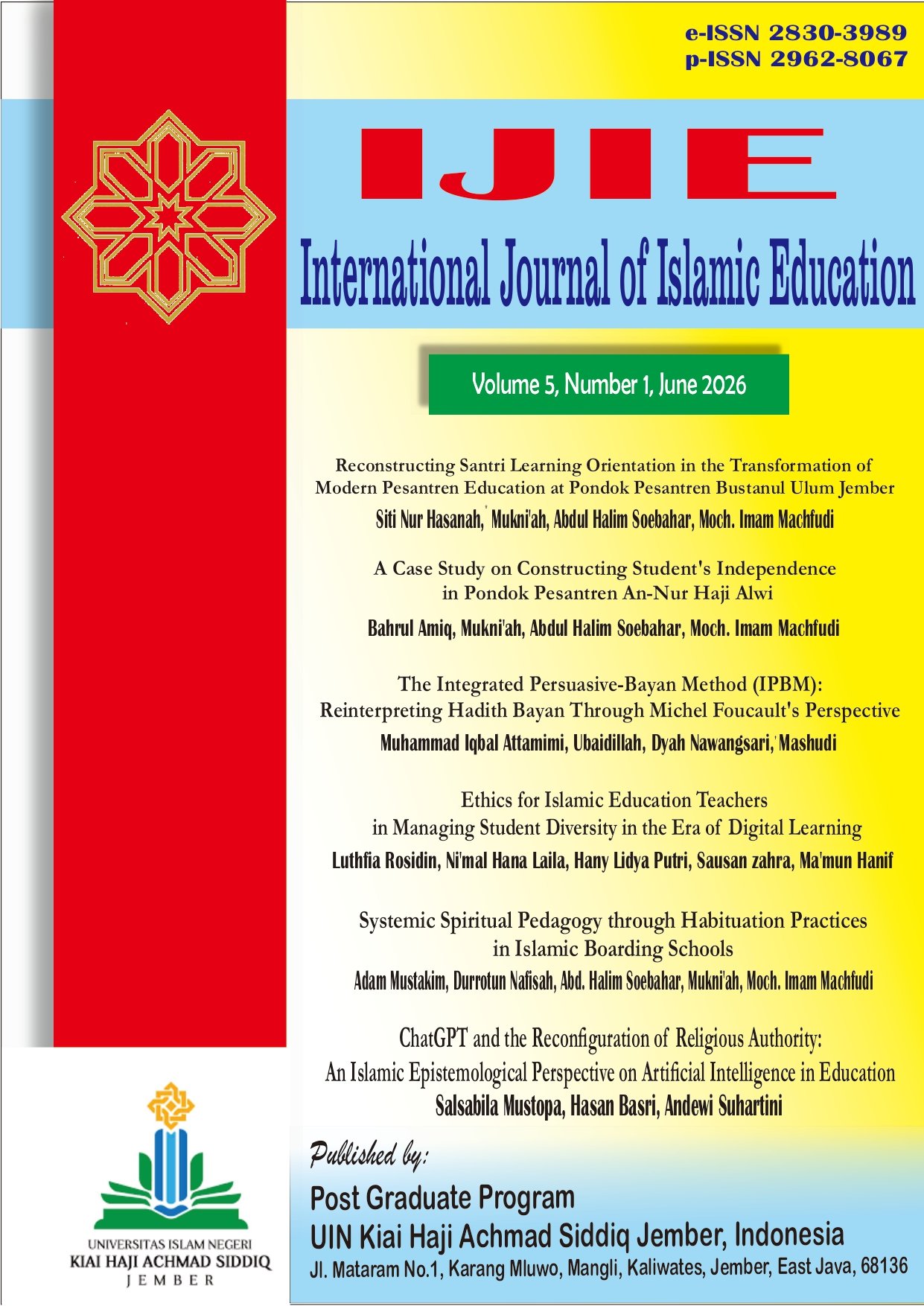
ChatGPT and the Reconfiguration of Religious Authority: An Islamic Epistemological Perspective on Artificial Intelligence in Education
DOI:
https://doi.org/10.35719/ijie.v5i1.2659Keywords:
Islamic Epistemology, Religious Authority, ChatGPT, Artificial Intelligence in EducationAbstract
The proliferation of artificial intelligence has significantly reshaped the landscape of religious knowledge production and authority in contemporary Islamic contexts. This study investigates how ChatGPT, as an emergent digital agent in religious discourse, can be epistemologically situated within classical Islamic frameworks. Employing a Systematic Literature Review (SLR) guided by PRISMA protocol and thematic analysis, this research pursues three objectives: (1) to philosophically characterize knowledge produced by ChatGPT; (2) to locate ChatGPT within the bayani burhani irfani epistemological framework; and (3) to propose a conceptual model of reconstructed religious authority responsive to digital religion, religious moderation, and Islamic Religious Education (PAI). The analysis establishes that ChatGPT's outputs are fundamentally derivative, probabilistic, and devoid of value commitment, placing it most appropriately within the burhani domain as an informational instrument requiring scholarly curation. A four-layer hierarchical model is proposed anchored in revelation and maqasid al-shari'ah at the apex, followed by ulama as curators, scientific methodology as burhani instrument, and AI as technical support. This study's novelty lies in the systematic integration of Islamic epistemology with digital religion theory to reconfigure religious authority in the AI era and advance religiously moderate PAI.
References
Abdillah, N., Hidayati, R., Kholis, N., & Najib, M. (2025). Digital transformation in Islamic religious education learning: A study of theory and implementation in schools. International Journal of Educational and Psychological Sciences, 3(4), 351–366.
Afwadzi, B. (2023). Interaksi Epistemologi Bayani, Burhani, dan Irfani dengan Pendidikan Agama Islam. Ma’arif Journal of Education, Madrasah Innovation and Aswaja Studies, 2(1), 29–37.
Ahmad, S. F., Rahmat, M. K., Mubarik, M. S., Alam, M. M., & Hyder, S. I. (2021). Artificial Intelligence and Its Role in Education. MDPI, 13(22). https://doi.org/https://doi.org/10.3390/su132212902
Akmaliah, W. (2020). The Demise of Moderate Islam: New Media, Contestation, and Reclaiming Religious Authorities. Indonesian Journal of Islam and Muslim Societies, 10(1), 1–24. https://doi.org/https://doi.org/10.18326/ijims.v10i1.1-24
Al-Attas, S. M. N. (1999). The Concept of Education in Islam: A Framework for an Islamic Philosophy of Education. ISTAC.
Al-Raysuni, A. (2005). Imam Al-Shatibi’s Theory of the Higher Objectives and Intents of Islamic Law. International Institute of Islamic Thought (IIIT).
Auda, J. (2008). Maqasid Al-shariah as Philosophy of Islamic Law: A Systems Approach. International Institute of Islamic Thought.
Azra, A. (2020). Pendidikan Islam dan Tantangan Modernitas: Menuju Paradigma Baru. Studia Islamika, 27(1), 1-28. Studia Islamika, 27(1), 1–28.
Booth, A., Sutton, A., & Papaioannou, D. (2016). Systematic approaches to a successful literature review (2nd ed.). SAGE Publications.
Booth, W. C., Colomb, G. G., Williams, J. M., Bizup, J., & FitzGerald, W. T. (2016). The Craft of Research (4th ed). The University of Chicago Press.
Breakstone, J., McGrew, S., & Wineburg, S. (2018). Why We Need a New Approach to Teaching Digital Literacy. Phi Delta Kappan, 99(6). https://doi.org/https://doi.org/10.1177/0031721718762419
Bunt, G. R. (2003). Islam in the Digital Age: E Jihad, Online Fatwas, and Cyber Islamic Environments. Pluto Press.
Bunt, G. R. (2018). Hashtag Islam: How Cyber-Islamic Environments are Transforming Religious Authority. University of North Carolina Press.
Campbell, H. A., & Evolvi, G. (2020). Contextualizing Current Digital Religion Research on Emerging Technologies. Human Behavior and Emerging Technologies, 2(1), 5–17. https://doi.org/https://doi.org/10.1002/hbe2.149
Campbell, H. A., & Tsuria, R. (2022). Digital Religion Understanding Religious Practice in Digital Media (2nd ed.). Routledge.
Chavanayarn, S. (2023). Navigating ethical complexities through epistemological analysis of ChatGPT. Bulletin of Science, Technology & Society, 43(3–4), 105–114.
Creswell, J. W., & Creswell, J. D. (2018). Research Design: Qualitative, Quantitative, and Mixed Methods Approaches (5th ed). SAGE Publications.
Darmu’in. (2025). Perceived Barriers to ChatGPT Integration in Islamic Studies Education: Insights from Malaysian International Students in Indonesia. 15(11), 141–164.
Denzin, N. K., & Lincoln, Y. S. (2018). The Sage Handbook of Qualitative Research (5th ed). Sage Publications.
Dierickx, L., Opdahl, A. L., Bjerknes, F., & Linden, C.-G. (2026). What Is a Fact in The Age of Generative AI? Fact-Checking as An Epistemological Lens. Information, Communication & Society, 1–18. https://doi.org/https://doi.org/10.1080/1369118X.2026.2630697
Dreyfus, H. L. (1992). What Computers Still Can’t Do: A Critique of Artificial Reason. MIT Press.
Eickelman, D. F., & Anderson, J. W. (2003). New Media in The Muslim World: The Emerging Public Sphere (2nd ed). Indiana University Press.
Faizin, N., Alfan, M., Basid, A., Ramadhan, M. R., Panatik, S. A., & Kawakip, A. N. (2025). Muslim Students’ Acceptance of Artificial Intelligence in Islamic Religious Education: an Extended TAM Approach. Discover Education, 4(1), 1–17. https://doi.org/10.1007/s44217-025-00767-1
Fauzi, M. R., Zahro, S. F., Bashith, A., & Hakim, M. J. M. (2025). Peluang dan Tantangan Integrasi Artificial Intelligence Dalam Evaluasi Pembelajaran Pendidikan Agama Islam. Educaia, 10(2). https://doi.org/https://doi.org/10.21462/educasia.v10i2.345
Floridi, L. (2011). The Philosophy of Information. Oxford University Press.
Floridi, L. (2014). The Fourth Revolution: How The Infosphere is Reshaping Human Reality. Oxford University Press.
Ganadi, A. El, Aftar, S., Gagliardelli, L., & Rouzzi, F. (2025). Generative AI for Islamic Texts: The EMAN Framework for Mitigating GPT Hallucinations. In Proceedings Og the 17th Conference on Agents and Artificial Intelegence (ICAART 2025), 3, 1221–1228. https://doi.org/10.5220/0013312800003890
Hallaq, W. B. (2009). Shari’a: Theory, Practice, Transformations. Cambridge University.
Hamid, S., & Bukhari, F. (2025). The Role of Islamic Ethical Principles in the Development and Deployment of Artificial Intelligence Technologies. VI(2).
Hamidalloh, A. S., Thobroni, A. Y., Suyudi, M., Islam, U., & Sunan, N. (2026). ChatGPT as an Algorithmic Epistemic Mediator in Contextual Islamic Religious Education and Religious Moderation. 5(1), 46–61.
Hanafi, Y., Saefi, M., Diyana, T. N., & Ikhsan, M. A. (2023). What Content Offers and How Teachers Teach: Religious Moderation-Integrated Teaching in Indonesia. HTS Teologiese Studies, 79(2). https://doi.org/10.4102/hts.v79i2.9070
Hefner, R. W. (2009). Making Modern Muslims: The Politics of Islamic Education in Southeast Asia. University of Hawai’i Press.
Hobbs, R. (2010). Digital and Media Literacy: A Plan of Action. Aspen Institute.
Huda, L. N., Linda, L., Syihabuddin, M., Firmansyah, A., & Herlambang, M. (2024). Al-Jabiri’s epistemology of bayani, irfani, burhani on the critique of Arabic reason and its correlation with Islamic education. PAKAR Pendidikan, 22 (2), 65–76.
Jabiri, M. A. (1990). Binyat Al- Aql Al- Arabi Dirasah Tahliliyah Naqdiyah Li-Nuzum Al-Ma Rifah Fi Al-Thaqafah Al- Arabiyah. Markaz Dirasat al-Wahdah al-‘Arabiyyah.
Kamali, M. H. (2003). Principles of Islamic Jurisprudence (3rd ed). Islamic Texts Society.
Kamali, M. H. (2015). The Middle Path of Moderation in Islam: The Qur’anic Principle of Wasatiyyah. Oxford University Press.
Luckin, R., Holmes, W., Griffiths, M., & Forcier, L. B. (2016). Intelligence Unleashed: An Argument for AI in Education. Pearson.
Ma’arif, M. J., Khoiriyah, S., & Anwar, S. (2025). Pesantren and Digital Literacy: Fiqh-Based Assessment of Islamic Teachers’ Competency in Strengthening Religious Moderation. EDUKASIA ISLAMIKA: Jurnal Pendidikan Islam, 10(2), 181 – 208. https://doi.org/10.28918/jei.v10i2.12117
Mandaville, P. (2007). Globalization and the Politics of Religious Knowledge: Pluralizing Authority in the Muslim World. Theory, Culture & Society, 24(2), 101–115.
Mehmood, M., Keerio, I. K., & Husnain, M. (2024). Artificial Intelligence in Islamic Studies Exploring Opportunities and Addressing Challenges. Al-Salihat: Journal of Women, Society, and Religion (Miscellaneous), 3(2).
Miles, M. B., & Huberman, A. M. (2014). Qualitative Data Analysis: An Expanded Sourcebook (3nd ed). Sage Publications.
Mukhibat, M., Effendi, M., Setyawan, W. H., & Sutoyo, M. (2024). Development and evaluation of religious moderation education curriculum at higher education in Indonesia. Cogent Education, 11(1). https://doi.org/10.1080/2331186X.2024.2302308
Mukminin, A., Hanun, A., & Musthofa, M. L. (2025). Integration of Bayani , Burhani and Irfani Epistemologies in Arabic Language Learning in Islamic Boarding School-Based Colleges Integrasi Epistemologi Bayani , Burhani , dan Irfani Dalam Pembelajaran Bahasa Arab di Perguruan Tinggi Berbasis Pesantren. 09(01), 91–107. https://doi.org/10.30762/asalibuna.v9i01.5292
Mulyana, R. (2023). Religious Moderation in Islamic Religious Education Textbook and Implementation in Indonesia. HTS Teologiese Studies, 79(1). https://doi.org/https://doi.org/10.4102/hts.v79i1.8592
Nasr, S. H. (2002). Islamic Science: An Illustrated Study. World Wisdom.
Niam, M. F. (2024). Does Artificial Intelligence Go Beyond The Limits of Religious Authority? An Ethical Review on IslamGPT. Al’Adalah: Jurnal Syariah Dan Hukum Islam, 27(1), 71 – 84. https://doi.org/https://doi.org/10.35719/aladalah.v27i1.477
Page, M. J., Mckenzie, J. E., Bossuyt, P. M., & Boutron, I. (2021). The PRISMA 2020 Statement: An Updated Guideline for Reporting Systematic Reviews. Journal of Clinical Epidemiology. https://doi.org/https://doi.org/10.1136/bmj.n71
Papakostas, C. (2025). Artificial Intelligence in Religious Education: Ethical, Pedagogical, and Theological Perspectives. Religions, 16(5), 563. https://doi.org/https://doi.org/10.3390/rel16050563
Patton, M. Q. (2002). Qualitative Research & Evaluation Methods (3th ed). Sage Publications.
Ramadhan, A. S. (2025). The relations between epistemology system of bayani, burhani, and irfani.
RI, T. P. K. A. (2019). Moderasi Beragama. Badan Litbang dan Diklat Kementerian Agama RI.
Russell, B. (2004). The Problems of Philosophy. Barnes & Noble Books.
Russell, S. J., & Norvig, P. (2010). Artificial Intelligence A Modern Approach (3th ed). Prentice Hall.
Salleh, N. S. N. M., Shamsuddin, N., Ibrahim, N., & Hamid, R. (2025). Fostering Learning Motivation: The Effects of AI (Artificial Intelligence) Adoption among Students in Higher Education Institutions. International Journal of Research and Innovation in Social Science (IJRISS), IX(III).
Singler, B. (2024). Religion and Artificial Intelligence: An Introduction. Routledge.
Tan, C. (2011). Islamic Education and Indoctrination: The Case in Indonesia. Routledge.
Wardle, C., & Derakhshan, H. (2017). Information Disorder: Toward an Interdisciplinary Framework for Research and Policy Making. Council of Europe.
Wibowo, R. A., & Triadi, I. (2025). Fatwa Di Era Disrupsi Digital: Studi Tentang Otoritas Agama Dan Pengaruh Media Sosial Terhadap Penetapan Hukum Islam. LexIslamica: A Multidisciplinary Approach to Islamic Law and Its Contemporary Applications, 1(3), 1–16. https://doi.org/10.33650/joki.v4i2
Yusuf, M. Z., Nahar, M. H., Abror, H. M., & Renaldi, M. H. (2024). Digital Strategies for Promoting Religious Moderation: The Role of Muhammadiyah and Nahdlatul Ulama on Social Media. International Journal of Nusantara Islam, 12(2), 116–130. https://doi.org/10.15575/ijni.v12i2.40448
Zaman, M. Q. (2002). The Ulama in Contemporary Islam: Custodians of Change. Princeton University Press.