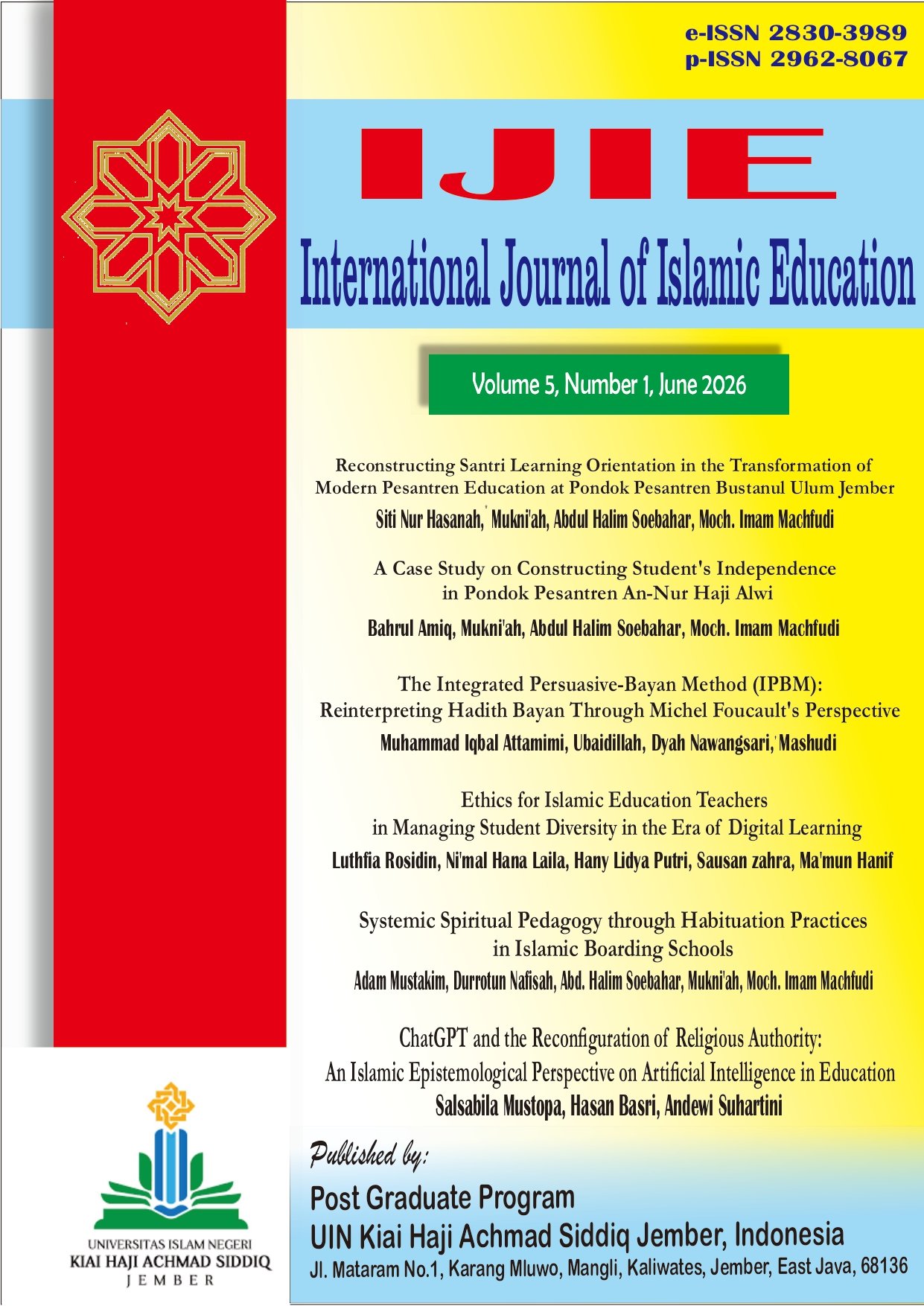
A Case Study on Constructing Student’s Independence in Pondok Pesantren An-Nur Haji Alwi
DOI:
https://doi.org/10.35719/ijie.v5i1.2637Keywords:
Independence Education, Pesantren, Islamic Boarding School, Santri Character, Islamic EducationAbstract
This study explores how student independence is constructed within the boarding system of Pondok Pesantren An-Nur Haji Alwi, Indonesia. It aims to examine the role of boarding culture, learning traditions, religious habituation, and daily social practices in shaping students’ independence. Employing a qualitative intrinsic case study design, data were collected through observations, semi-structured interviews, and document analysis involving pesantren caregivers, teachers, administrators, and students. Data were analyzed using the interactive model of Miles, Huberman, and Saldaña. The findings reveal that student independence is developed through four interconnected dimensions: personal, academic, social, and spiritual independence. Personal independence emerges through self-management and daily routines; academic independence is fostered through learning traditions such as sorogan, discussion, and collaborative study; social independence is strengthened through organizational participation and collective activities; while spiritual independence is embeded through continuous worship practices and religious discipline. The boarding system functions as an integrative environment that continuously reinforces these dimensions through everyday socio-religious interactions. The originality of this study lies in conceptualizing student independence as a multidimensional socio-religious construct shaped by the interaction of boarding culture, collective responsibility, and spiritual habituation. The findings contribute to Islamic education scholarship by providing insights for the development of character and independence education in Islamic boarding schools.
References
Abdurrohman, I., Mudana, I. W., & Ketut, I. (2025). The role of the hidden curriculum in fostering toler-ance: A case study of public high schools in Mataram City. Educational Process: International Journal, 15, e2025160. https://doi.org/10.22521/edupij.2025.15.160
Alam, M. A. (2023). From teacher-centered to student-centered learning: The role of constructivism and connectivism in pedagogical transformation. Journal of Education, 11(2), 154–167.
Al-Otaibi, H. H. (2022). The role of habituation in changing the individual’s character traits in Islamic ethics (Master’s thesis, Hamad Bin Khalifa University, Qatar).
Anggito, A., & Setiawan, J. (2018). Metodologi penelitian kualitatif. Jejak.
Anshu, Gupta, P., & Singh, T. (2022). The concept of self-directed learning: Implications for practice in the undergraduate curriculum. https://doi.org/10.1007/s13312-022-2501-x
Azra, A. (2012). Pendidikan Islam: Tradisi dan modernisasi di tengah tantangan milenium III. Kencana.
Creswell, J. W., & Creswell, J. D. (2018). Research design: Qualitative, quantitative, and mixed methods approaches (5th ed.). SAGE Publications.
Denzin, N. K. (2017). The research act: A theoretical introduction to sociological methods. Routledge.
Denzin, N. K., & Lincoln, Y. S. (2018). The SAGE handbook of qualitative research (5th ed.). SAGE Publica-tions.
Dhofier, Z. (1994). Tradisi pesantren: Studi tentang pandangan hidup kyai. LP3ES.
Fauzi, I., et al. (2022). The pattern of development of competence, commitment, and motivation of teach-ers in pesantren. Al-Tanzim: Jurnal Manajemen Pendidikan Islam, 6(4). https://doi.org/10.33650/al-tanzim.v6i4.3703
Goffman, E. (1961). Asylums: Essays on the social situation of mental patients and other inmates. Anchor Books.
Hefner, R. W. (2009). Making modern Muslims: The politics of Islamic education in Southeast Asia. Princeton Uni-versity Press.
Huda, M. (2024). Strengthening religious moderation through the core values of Islamic boarding school education. Al-Hayat: Journal of Islamic Education. https://doi.org/10.35723/ajie.v8i2.458
Ihsan, I. (2024). Curriculum management in pesantren-based madrasah for strengthening religious modera-tion. Quality: Journal of Empirical Research in Islamic Education. https://journal.iainkudus.ac.id/index.php/Quality/article/view/30677
Kawakip, A. N., & Sulanam, S. (2023). The practice of shared values and Islamic educational identity: Ev-idence from a pesantren in East Java, Indonesia. Journal of Indonesian Islam, 17(1), 27–53. https://doi.org/10.15642/JIIS.2023.17.1.27-53
Kawakip, A., & Sulanam, S. (2023). The practice of shared values and Islamic educational identity: Evi-dence from a pesantren in East Java, Indonesia. Journal of Indonesian Islam, 17(1), 27–53. https://doi.org/10.15642/JIIS.2023.17.1.27-53
Knowles, M. S. (1975). Self-directed learning: A guide for learners and teachers. Cambridge Adult Education.
Kolb, D. A. (1984). Experiential learning: Experience as the source of learning and development. Prentice Hall.
Kvale, S., & Brinkmann, S. (2015). InterViews: Learning the craft of qualitative research interviewing (3rd ed.). SAGE Publications.
Lukens-Bull, R. (2005). A peaceful jihad: Negotiating identity and modernity in Muslim Java. Palgrave Macmillan. https://doi.org/10.1057/9781403982753
Ma’arif, M. A., & Arif, M. (2026). Sustaining character education in pesantren: A holistic and culturally embedded learning ecosystem. Jurnal Cakrawala Pendidikan, 45(2). https://journal.uny.ac.id/index.php/cp/article/view/94968
Madjid, N. (1997). Bilik-bilik pesantren: Sebuah potret perjalanan. Paramadina.
Merriam, S. B., & Tisdell, E. J. (2016). Qualitative research: A guide to design and implementation (4th ed.). Jossey-Bass.
Miles, M. B., Huberman, A. M., & Saldaña, J. (2020). Qualitative data analysis: A methods sourcebook (4th ed.). SAGE Publications.
Mingorance Estrada, Á. C., Granda Vera, J., Rojas Ruiz, G., & Alemany Arrebola, I. (2019). Flipped class-room to improve university student-centered learning and academic performance. Social Sciences, 8(11), 315. https://doi.org/10.3390/socsci8110315
Mistar, J., Anwar, S., & Azizah, N. (2025). Fostering tolerance through the hidden curriculum: An ethno-graphic study of inclusive education in an Indonesian Islamic boarding school. Munaddhomah: Jurnal Manajemen Pendidikan Islam, 6(4), 603–617. https://doi.org/10.31538/munaddhomah.v6i4.1960
Moleong, L. J. (2017). Metodologi penelitian kualitatif. Remaja Rosdakarya.
Muhith, A., Baitulah, R., & Wahid, A. (2020). Metodologi penelitian. Bildung Nusantara.
Mujahid, I. (2021). Islamic orthodoxy-based character education: Creating moderate Muslims in a modern pesantren in Indonesia. Indonesian Journal of Islam and Muslim Societies, 11(2), 185–212. https://doi.org/10.18326/ijims.v11i2.185-212
Nur, H. (2025). The implementation of an outdoor learning-based instructional model in the fiqh course at the Institute Pesantren Babakan Cirebon. Journal of Teaching and Learning, 4(1), 1–18. https://jtl.staiku.ac.id/index.php/jtl/article/view/52
Pageh, I. M., Mudana, I. W., & Margi, I. K. (2025). The role of the hidden curriculum in fostering toler-ance: A case study of public high schools in Mataram City. Educational Process: International Journal, 15, e2025160. https://doi.org/10.22521/edupij.2025.15.160
Rofiah, N. H., Kawai, N., & Sudiraharja, D. (2025). Pesantren and inclusion: Bridging religion and disabil-ity in Islamic education in Indonesia. African Journal of Disability, 14, 1741. https://doi.org/10.4102/ajod.v14i0.1741
Saldaña, J. (2021). The coding manual for qualitative researchers (4th ed.). SAGE Publications.
Salim, N. A., Zaini, M., Wahib, A., Fauzi, I., & Asnawan, A. (2024). Fostering moderate character of santri: Effective hidden curriculum strategy in Islamic boarding schools. Nazhruna: Jurnal Pendidi-kan Islam, 7(2), 357–372. https://doi.org/10.31538/nzh.v7i2.4676
Stake, R. E. (1995). The art of case study research. SAGE Publications.
Stauth, G. (2015). Politics and cultures of Islamization in Southeast Asia: Indonesia and Malaysia in the nineteen-nineties. transcript Verlag.
Sugiyono. (2018). Metode penelitian evaluasi: Pendekatan kuantitatif, kualitatif, dan kombinasi. Alfabeta.
Tilaar, H. A. R. (2000). Paradigma baru pendidikan nasional. Rineka Cipta.
van Bruinessen, M. (1999). Kitab kuning, pesantren, dan tarekat: Tradisi-tradisi Islam di Indonesia. Mizan.
Vygotsky, L. S. (1978). Mind in society: The development of higher psychological processes. Harvard University Press.
Wahid, A. (1995). Pesantren dan pembaharuan. LP3ES.
Yin, R. K. (2018). Case study research and applications: Design and methods (6th ed.). SAGE Publications.
Zainuri, M., Mu'alimin, M. A., & Umam, K. (2025). Boarding school and character education: Exploring moral development in Islamic educational institutions in Indonesia. Benchmarking, 9(1), 130–138. http://dx.doi.org/10.30821/benchmarking.v9i1.24575
Zarkasyi, H. F. (2022). Islamic boarding school reform and educational transformation in Indonesia. Jour-nal of Indonesian Islam, 16(1), 1–24. https://doi.org/10.15642/JIIS.2022.16.1.1-24
Zimmerman, B. J. (2002). Becoming a self-regulated learner: An overview. Theory Into Practice, 41(2), 64–70. https://doi.org/10.1207/S15430421TIP4102_2