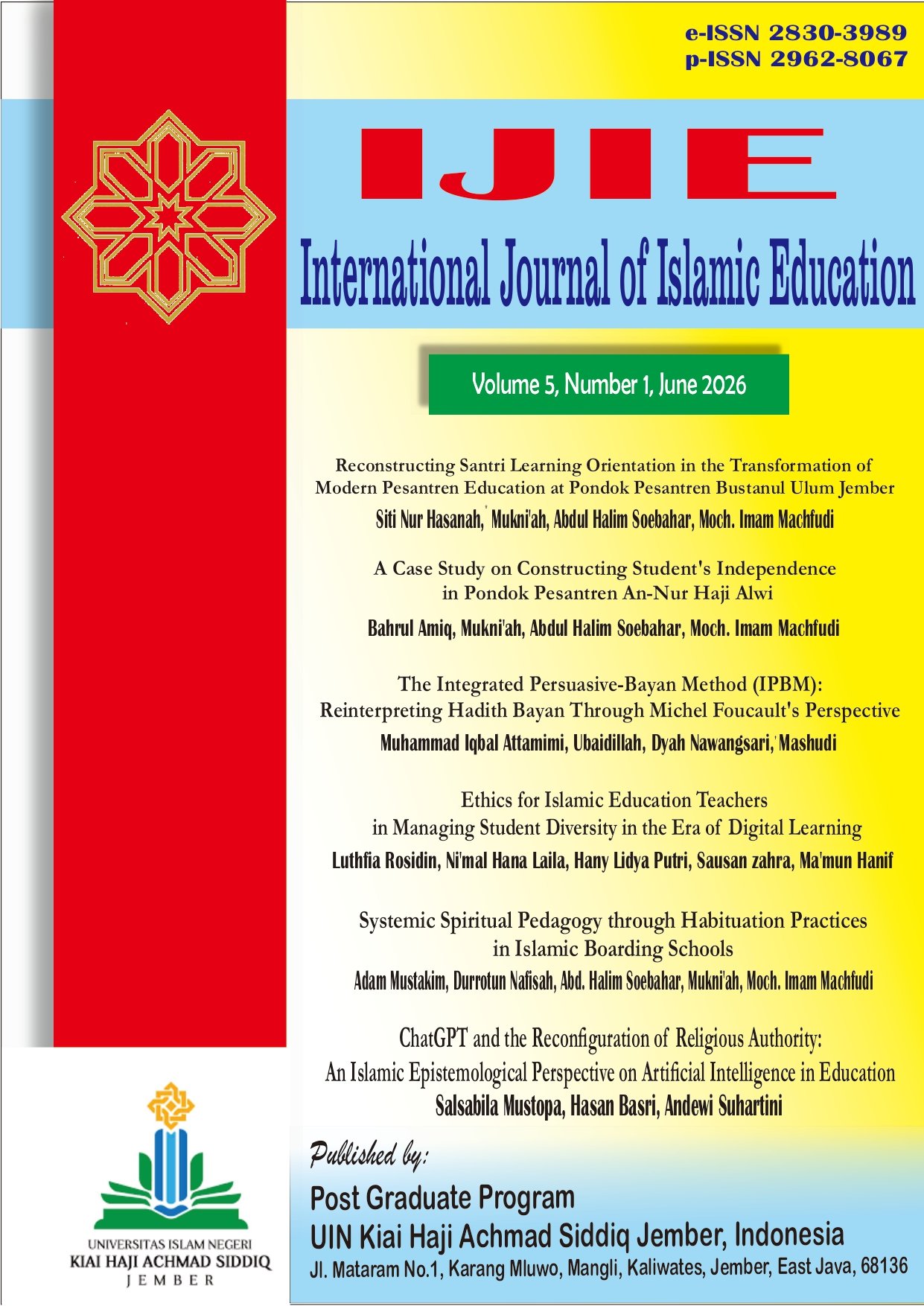
Systemic Spiritual Pedagogy through Habituation Practices in Islamic Boarding Schools
DOI:
https://doi.org/10.35719/ijie.v5i1.2634Keywords:
Systemic Spiritual Pedagogy, Habituation-Based Learning, Spiritual Character Formation, Islamic Boarding SchoolsAbstract
Contemporary instructional design has emphasized measurable achievement while giving limited attention to spiritual development. Although Islamic boarding schools (pesantren) have long cultivated character, spirituality, habituation, and character education are commonly studied as separate domains. This study proposes Systemic Spiritual Pedagogy as an integrated framework for spiritual character formation. Using a qualitative single-case study at Amanatul Ummah Islamic Boarding School, Indonesia, data were collected through participant observation, semi-structured interviews, and document analysis. The findings reveal three interconnected mechanisms: (1) institutional integration of spirituality into educational planning and regulations; (2) systematic habituation through twenty-four-hour religious, disciplinary, and social practices; and (3) continuous multidimensional evaluation of students’ academic, behavioral, disciplinary, and spiritual development. These mechanisms form a unified pedagogical cycle linking planning, implementation, and evaluation. By integrating Gagné’s Conditions of Learning with Al-Ghazali’s tazkiyatun nafs, the study extends instructional design theory and provides a systematic framework for embedding spirituality into holistic education.
References
Al-Ghazali, A. H. (2005). Ihya’ Ulum al-Din. Jilid III. Beirut: Dar al-Kutub al-‘Ilmiyyah.
Azra, A. (2019). Pendidikan Islam: Tradisi dan Modernisasi Menuju Milenium Baru. Jakarta: Kencana.
Biesta, G. (2007). Why What Works Won’t Work: Evidence-Based Practice and the Democratic Deficit in Educational Research. Educational Theory, 1-22.
Biesta, G. (2021). World-Centred Education: A View for the Present. London: Routledge.
Dhofier, Z. (2019). Tradisi Pesantren: Studi tentang Pandangan Hidup Kiai dan Visinya Mengenai Masa Depan Indonesia. Jakarta: LP3ES.
Fauziah, I. D. (2025). Keteladanan sebagai metode pendidikan islam dalam pembentukan karakter peserta didik. Al-Iltizam: Jurnal Pendidikan Agama Islam, 130-138.
Firdausiyah, R. A. (2025). Modernization of Islamic boarding school: Adaptation of traditional values in contemporary Islamic education. Proceeding of International Conference on Education, Soceity and Humanity, 657-669.
Gagné, R. M. (2005). Principles of Instructional Design. 5th ed. Belmont. CA: Wadsworth/Thomson Learning.
Lincoln, Y. S. (1985). Naturalistic Inquiry. Newbury Park. CA: SAGE Publication.
Ma’muroh, A. A. (2024). The Concept of Tazkiyatun Nafs by Al-Ghazali and Its Implementation at Pesantren Darut Tasbih Tangerang. Edu Cendikia: Jurnal Ilmiah Kependidikan, 833-844.
Mahrus, M. A. (2026). Spiritual Pedagogy of the Sufism Model in Pesantren: Effectively Shaping Inclusive and Moderate Character Among Students. Mumtaz, 1227-1259.
Merrill, M. D. (2020). First Principles of Instruction: Identifying and Designing Effective, Efficient and Engaging Instruction. Educational Technology Research and Development, 2537-2547.
Miles, M. B. (2020). Qualitative Data Analysis: A Methods Sourcebook. 4th ed. Los Angles: SAGE Publications.
Muzaki, M. K. (2026). Internalization of Islamic boarding school values and their implications for the formation of student discipline. Journal of Educational Management Research, 1031-1045.
OECD. (2023). Future of Education and Skills 2030: Conceptual Learning Framework. . Paris: OECD Publishing.
Reimers, F. M. (2021). Education and Climate Change: The Role of Universities. Cham: Springer Nature.
Republik Indonesia. (2003). Undang-Undang Nomor 20 Tahun 2003 tentang Sistem Pendidikan Nasional. . Jakarta: Sekretariat Negara Republik Indonesia.
Republik Indonesia. (2019). Undang-Undang Nomor 18 Tahun 2019 tentang Pesantren. Jakarta: Sekretariat Negara Indonesia.
Trisnantari, H. E. (2026). Internalizing Religious Values through Habituation: Strengthening Students’ Character in the Digital Era. Al-Hayat: Journal of Islamic Education, 215-225.
UNESCO. (2021). Reimagining Our Futures Together: A New Social Contract for Education. Paris: UNESCO Publishing.
Yin, R. K. (2018). Case Study Research and Applications: Design and Methods. 6th ed. Thousand Oaks. CA: SAGE Publications.
Zukdi, I. Z. (2022). The Role of Islamic Boarding Schools in Building the Character of the Nation. Edukasi Islami: Jurnal Pendidikan Islam, 45-60.