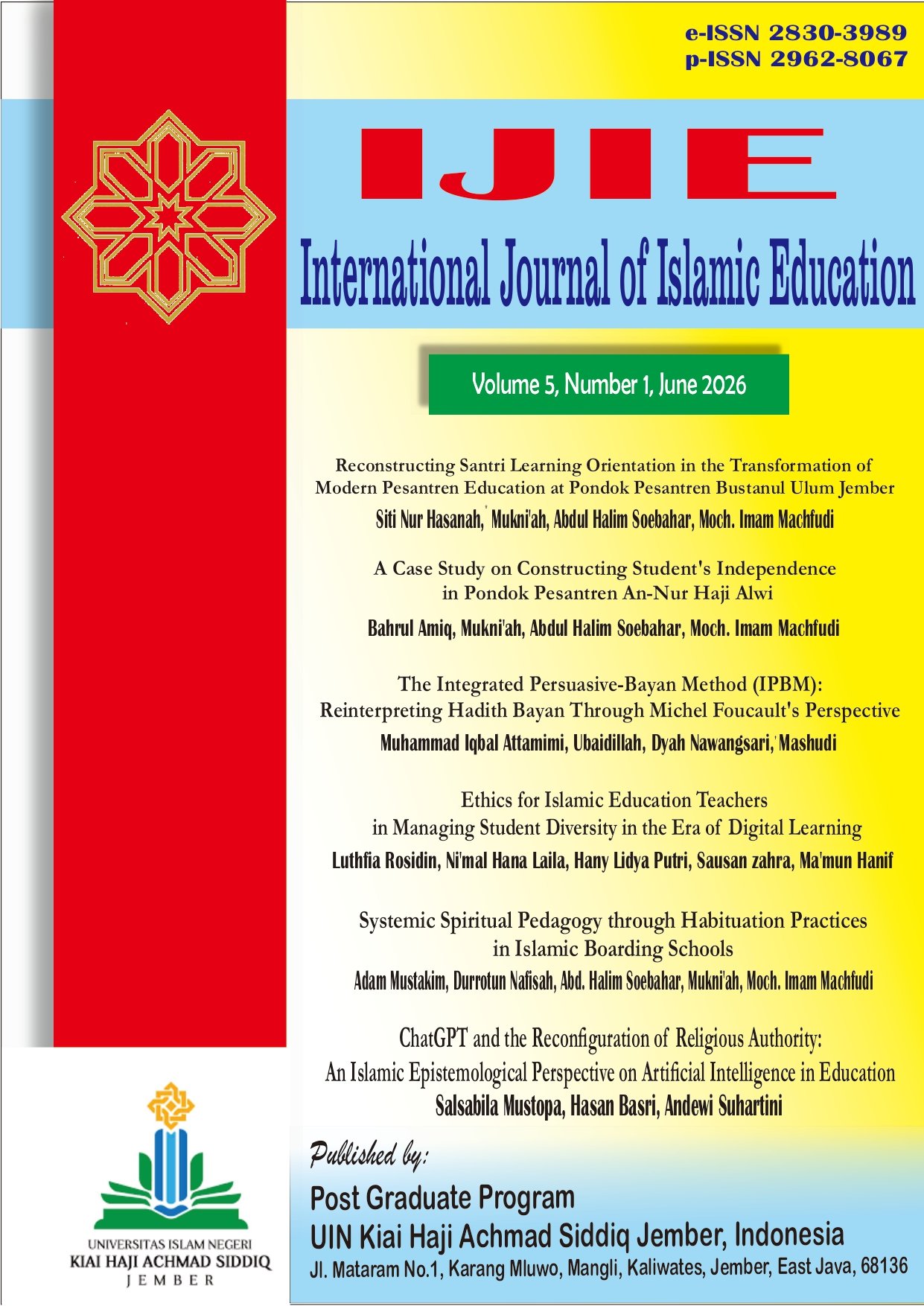
Reconstructing Santri Learning Orientation in the Transformation of Modern Pesantren Education at Pondok Pesantren Bustanul Ulum Jember
DOI:
https://doi.org/10.35719/ijie.v5i1.2614Keywords:
Pesantren Transformation, Santri Learning Orientation, Epistemological Fragmentation, Islamic EducationAbstract
This study examines the transformation of santri learning orientations within the integration of pesantren, formal schooling, and higher education at Pondok Pesantren Bustanul Ulum Jember. Using a qualitative descriptive approach, data were collected through interviews, observations, focus group discussions, and document analysis involving kyai, administrators, and three santri typologies: Santri Kitab, Santri Siswa, and Mahasantri. The findings show that educational integration in the pesantren does not fully produce epistemological coherence. Instead, it creates differentiated learning orientations, uneven intellectual trajectories, and tensions between traditional religious learning and modern academic demands. Santri kitab tends to maintain text-centered religious authority, students experience academic overload within dual educational systems, while mahasantri face identity ambivalence between pesantren values and contemporary academic culture. This study introduces the concept of hybrid-fragmented learning orientationto explain how integration and fragmentation coexist within modern pesantren education. The study argues that pesantren transformation involves not only institutional modernization but also the negotiation of knowledge, authority, and santri identity. These findings contribute to contemporary Islamic education studies by offering a critical perspective on the complexities of educational integration in modern pesantren education.
References
Abidin, A. Z. (2021). Transformasi pendidikan pesantren di era globalisasi. Jurnal Pendidikan Islam, 9(2), 145–158.
American Educational Research Association. (2011). Ethical standards of research. American Educational Research Association.
Azra, A. (2022). Islamic education and reintegration of knowledge. Studia Islamika, 29(1), 1–20.
Bano, M. (2020). Modern Islamic education and the challenges of globalization. Comparative Education Review, 64(3), 398–405. https://doi.org/10.1086/709052
Burhani, A. N. (2021). The fragmentation of religious authority in contemporary Indonesian Islam. Asian Journal of Social Science, 49(1–2), 115–123. https://doi.org/10.1163/15685314-bja10018
Creswell, J. W., & Poth, C. N. (2018). Qualitative inquiry and research design: Choosing among five approaches (4th ed.). Sage.
Denzin, N. K., & Lincoln, Y. S. (Eds.). (2018). The SAGE handbook of qualitative research (5th ed.). Sage.
Dhofier, Z. (1994). Tradisi pesantren: Studi tentang pandangan hidup kyai. LP3ES.
Fathurrohman, M. (2023). Pesantren dan pembentukan intelektual Muslim kontemporer. Jurnal Studi Keislaman, 11(1), 89–95.
Fauzi, A. (2022). Student learning adaptation in Islamic boarding schools. International Journal of Islamic Education, 10(1), 67–72.
Geertz, C. (1960). The religion of Java. University of Chicago Press.
Guba, E. G., & Lincoln, Y. S. (1994). Competing paradigms in qualitative research. In N. K. Denzin & Y. S. Lincoln (Eds.), Handbook of qualitative research (pp. 105–117). Sage.
Hasan, N. (2012). Education, young Islamists and integrated Islamic schools in Indonesia. Studia Islamika, 19(1), 77–111. https://doi.org/10.15408/sdi.v19i1.370
Hashim, R. (2021). Rethinking Islamic education in facing the challenges of the 21st century. Journal of Muslim Minority Affairs, 41(1), 25–30. https://doi.org/10.1080/13602004.2021.1889481
Hidayati, N. (2024). Digitalisasi pembelajaran di pesantren: Tantangan dan peluang. Jurnal Teknologi Pendidikan Islam, 7(2), 120–126.
Karim, A. (2025). Paradigma baru pendidikan pesantren. Jurnal Pendidikan Agama Islam, 10(1), 33–40.
Maemunah, S. (2022). Integrasi kurikulum pesantren dan pendidikan formal dalam meningkatkan kompetensi santri. Jurnal Ilmu Pendidikan Islam, 5(1), 67–72. https://doi.org/10.54259/diajar.v1i1.192
Masud, M. K. (2022). Islamic education and global knowledge economy. International Journal of Islamic Thought, 21, 2–18. https://doi.org/10.24035/ijit.21.2022.235
Merriam, S. B., & Tisdell, E. J. (2016). Qualitative research: A guide to design and implementation (4th ed.). Jossey-Bass.
Miles, M. B., Huberman, A. M., & Saldaña, J. (2014). Qualitative data analysis: A methods sourcebook (3rd ed.). Sage.
Morgan, D. L. (2019). Focus groups as qualitative research (3rd ed.). Sage. https://doi.org/10.4135/9781526416070
Patton, M. Q. (2015). Qualitative research & evaluation methods (4th ed.). Sage.
Sahin, A. (2018). New directions in Islamic education: Pedagogy and identity formation. Kube Publishing.
Seidman, I. (2013). Interviewing as qualitative research: A guide for researchers in education and the social sciences (4th ed.). Teachers College Press.
Soebahar, A. H. (2013). Modernisasi pesantren. LKiS.
Tan, C. (2014). Educative tradition and Islamic schools in Indonesia. Journal of Arabic and Islamic Studies, 14, 47–62. https://doi.org/10.5617/jais.4647
Yin, R. K. (2018). Case study research and applications: Design and methods (6th ed.). Sage.
Zaidiyyah, R. (2023). Digital transformation in Islamic boarding schools and reconstruction of religious authority. Qudus International Journal of Islamic Studies, 11(2), 355–378. https://doi.org/10.21043/qijis.v11i2.18652
Gusmian, I., & Abdullah, M. (2022). Knowledge transmission and kyai-santri network in pesantren in Java Island during the 20th century: A study on Popongan manuscript. Afkar: Jurnal Akidah dan Pemikiran Islam, 24(1), 159–190. https://doi.org/10.22452/afkar.vol24no1.5
Hadi, M. (2022). Formalization of education management: A challenge to Indonesia’s traditional pesantren system. Eurasian Journal of Educational Research, 101, 1–18.
Halim, W., & Nubowo, A. (2025). Muhammadiyah Bugis-Makassar: Dispersal of Muslim organizations in and from South Sulawesi, Indonesia. Studia Islamika, 32(2), 313–346. https://doi.org/10.36712/sdi.v32i2.42544
Isnadia, R., & Safitri, D. A. (2026). Management of the integration of kitab kuning in PAI teaching materials: Optimization of the sorogan and bandongan methods in contemporary madrasahs. MANAGIERE: Journal of Islamic Educational Management, 5(1), 55–64.
Kawakip, A. N., & Sulanam, S. (2023). The practice of shared values and Islamic educational identity: Evidence from a pesantren in East Java, Indonesia. Journal of Indonesian Islam, 17(1), 27–53. https://doi.org/10.15642/JIIS.2023.17.1.27-53
Matin, U. A., & Millie, J. (2022). Islamic particularity and academic freedom: Public institutions and doctrinal difference in contemporary Indonesia. Journal of Southeast Asian Studies, 53(3), 441–458. https://doi.org/10.1017/S002246342200042X
Nurtawab, E. (2025). Indonesia’s pesantren law of 2019: New developments in the bureaucratisation of Islamic education. Religion, State & Society, 53(3), 236–252. https://doi.org/10.1080/09637494.2025.2563958
Qorib, M. (2025). Socio-cultural transformation within Indonesian academics: Cases in Muhammadiyah and Nahdlatul Ulama universities. Asian Education and Development Studies, 14(4), 856–875. https://doi.org/10.1108/AEDS-12-2024-0295
Riwanda, A., Abdurrohim, Widiyati, E., & Pranajaya, S. A. (2025). Science and religion integration in Indonesian Islamic senior high schools: Analyzing teachers’ pedagogical practices. Science & Education, 1–21. https://doi.org/10.1007/s11191-025-00648-x
Rohim, M. A., Musthofa, M. A., Hilmy, M., & Fuad, A. Z. (2026). Institutional differentiation and educational politics in Indonesian Islamic educational institutions. Journal of Science and Education, 6(2), 1353–1373.
Suresman, E., Faqihuddin, A., Jenuri, & Abdullah, M. (2025). From sorogan to digital learning: A systematic literature network analysis of pesantren learning models. Cogent Education, 12(1), 2580776. https://doi.org/10.1080/2331186X.2025.2580776
Suradji, M., & Faridi, F. (2025). Transformation of Islamic boarding school education in the digital era: A critical analysis of the internalization of Qur’anic values. Benchmarking, 9(2), 429–435.
Wahono, M., Budimansyah, D., Malihah, E., & Fitriasari, S. (2023). The role of social capital of Islamic students (santri) in facing the impacts of globalization: A case study at Buntet Islamic Boarding School. Society, 11(2), 377–397. https://doi.org/10.33019/society.v11i2.591