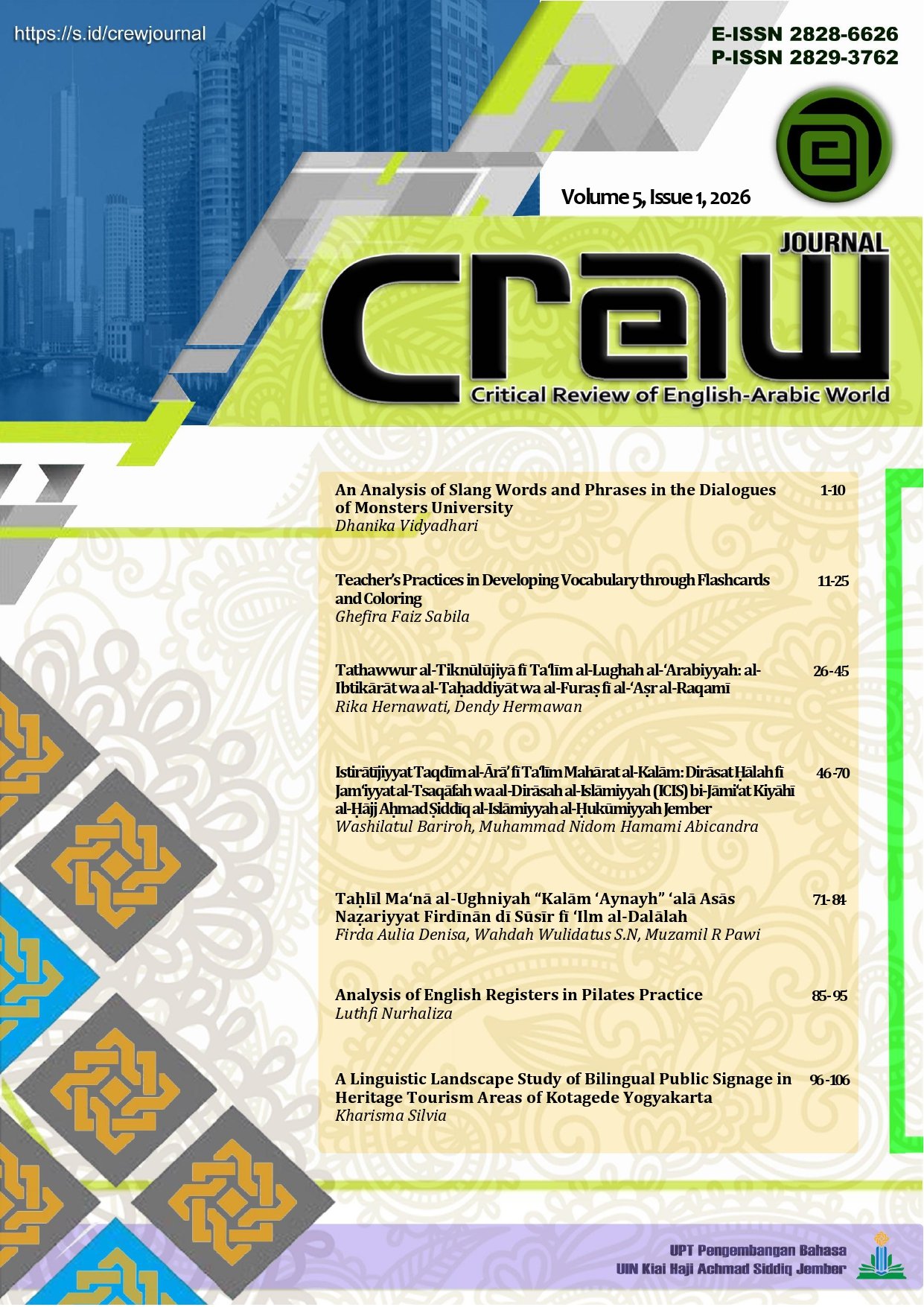
A Linguistic Landscape Study of Bilingual Public Signage in Heritage Tourism Areas of Kotagede Yogyakarta
DOI:
https://doi.org/10.35719/crewjournal.v5i1.2720Keywords:
Linguistic Landscape, Public Signage, Heritage Tourism, Functional Effectiveness, KotagedeAbstract
This study explores the linguistic landscape in the heritage tourism area of Kotagede, Yogyakarta. It aims to identify the varieties of language used on public signs and to evaluate their effectiveness in terms of their informative and symbolic functions in public spaces. Employing a purely qualitative approach through photographic documentation, 12 samples of public signage were purposively selected from the Kotagede Traditional Market area, the Gedhe Mosque Complex, and the courtyard of the Royal Cemetery of the Mataram Kings. The findings reveal a dynamic contestation among Indonesian as the national language, English as the language of global tourism, and the Javanese language and script as symbols of local culture. Functionally, the linguistic landscape of Kotagede is considered sufficiently effective in guiding tourists and highly effective in projecting the identity and authentic atmosphere of a heritage city amid the forces of modernization.
Downloads
Published
How to Cite
Issue
Section
License
Copyright (c) 2026 Kharisma Silvia

This work is licensed under a Creative Commons Attribution 4.0 International License.